
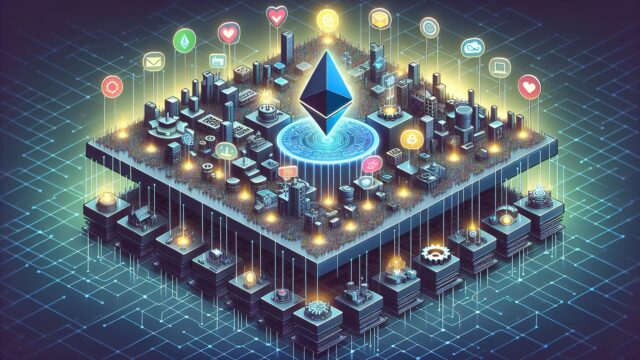
Welcome to the evolving world of Web3, a new paradigm of decentralized applications (dApps), smart contracts, and token economies. Ethereum is unarguably the heart of this movement, a protocol that has become synonymous with the concept of Web3. This article will delve deep into Ethereum, its purposes, innovations, and how it’s laying the groundwork for a decentralized future.
Introduction
Ethereventures into decentralization started with the proposition of a trustless, peer-to-peer network for managing and confirming transactions. Bitcoin paved the way with its blockchain technology. However, it’s Ethereum’s protocol, introduced in 2015, that has taken the concept further by creating a platform not just for cryptocurrency but for decentralized applications as well.
Ethereum extended the blockchain’s capabilities, welcoming developers and creators to fashion a world where applications run on a P2P network, data ownership is restored to users, and middlemen are obsolete. It’s a protocol that has become the architect of a new internet – the internet of value.
Body
The Genesis of Ethereum
Ethereum was proposed in late 2013 by Vitalik Buterin, a programmer and co-founder of Bitcoin Magazine. Displeased with Bitcoin’s limited scripting language, Buterin aimed to create a more powerful and flexible blockchain. Ethereum, as a platform, would allow developers to create not only tokens but any kind of decentralized application imaginable.
Smart Contracts: The Building Blocks
At the core of Ethereum are smart contracts, self-executing contracts with the terms of the agreement directly written into code. These contracts run on the blockchain, which means they operate exactly as programmed without any possibility of downtime, censorship, fraud, or interference.
Smart contracts are the backbone of all dApps built on Ethereum. They enable functionalities ranging from creating tokens and crowdfunding projects to automated decentralized organizations and even games.
The Ethereum Virtual Machine (EVM)
A key innovation of Ethereum is the Ethereum Virtual Machine (EVM), which acts as a runtime environment for smart contracts. The EVM is Turing-complete, meaning it can execute any computation given the necessary resources. This flexibility is what makes Ethereum the preferred platform for Web3 development.
Ether: The Native Cryptocurrency
Ether (ETH) is the native cryptocurrency of the Ethereum platform used to compensate participants who perform computations and validate transactions. It’s also used for ‘gas,’ a unit that measures the amount of computational effort required to execute operations like transactions and smart contracts.
Decentralized Finance (DeFi)
One of the most significant developments catalyzed by Ethereum is the emergence of Decentralized Finance, or DeFi. DeFi uses smart contracts to create protocols that replicate existing financial services in a decentralized architecture, outside of traditional financial systems.
Non-Fungible Tokens (NFTs)
Ethereum is at the forefront of the NFT revolution. NFTs are unique digital assets that represent ownership of specific items, which can be anything from digital art to ownership records for physical assets.
Constant Evolution: Ethereum 2.0
Ethereum is not without its flaws. Scalability issues and high gas fees have been significant concerns. Ethereum 2.0, also known as Eth2 or Serenity, is an upgrade aiming to improve the network’s scalability and security through a shift from Proof of Work (PoW) to Proof of Stake (PoS).
The Challenges Ahead
While Ethereum is a pioneering force in the Web3 space, it faces challenges. Scalability and high transaction fees remain critical issues, while up-and-coming protocols pose stiff competition. The community’s response to these challenges with incremental improvements and the shift to Ethereum 2.0 will be critical for its continued dominance.
Conclusion
Ethereum is much more than a cryptocurrency. It is a dynamic platform that allows for the decentralized future we’ve long been envisioning. Through smart contracts and the Ethereum Virtual Machine, it has expanded blockchain’s potential far beyond simple financial transactions. Ethereum is the touchstone for dApps, DeFi, and NFTs and holds a pivotal place in building the Web3 space.
With Ethereum 2.0 on the horizon, the protocol is set for a transformation that promises greater efficiency and a sustainable framework for future innovation. As the backbone of the Web3 ecosystem, Ethereum’s journey will strongly influence the shape of this emergent, decentralized internet, making it a thrilling space to watch for developers, investors, enthusiasts, and visionaries alike.