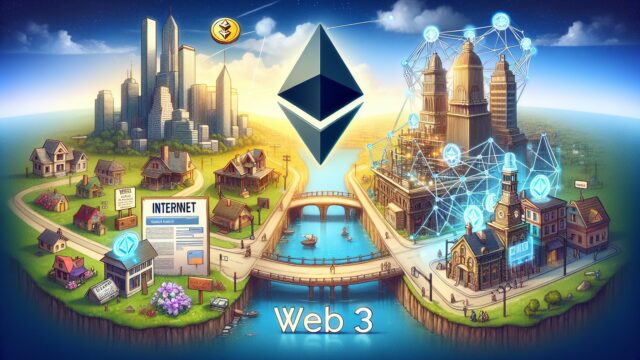
Exploring the Landscape of Web3 Protocols with Ethereum

As we navigate the complex and rapidly-evolving world of Web3, it’s crucial to understand the foundations upon which this new internet paradigm is built. Among the myriad of protocols empowering Web3, Ethereum stands out as one of the most influential and transformative platforms. In this article, we will delve into the intricacies of Ethereum, explore its features, and ponder its implications on the future of decentralized applications (dApps) and digital sovereignty.

Introduction

The advent of blockchain technology heralded a new era of decentralized digital assets, exemplified by cryptocurrencies like Bitcoin. However, the scope of blockchain’s potential extends far beyond mere currency. This is where Ethereum enters the scene, offering a versatile and powerful foundation for a whole spectrum of decentralized solutions. Ethereum’s contribution to Web3 extends far beyond financial transactions, encompassing the domains of self-executing contracts, decentralized governance, and more.

Body

What is Ethereum?

Ethereum is an open-source, blockchain-based platform that enables developers to build and deploy smart contracts and decentralized applications without the need for centralized intermediaries. Created by Vitalik Buterin and launched in 2015, Ethereum sought to expand the capabilities of blockchain beyond Bitcoin’s original scope of being a peer-to-peer electronic cash system.

Ethereum’s Technical Foundation

The core of Ethereum’s prowess lies in its blockchain, which is similar to Bitcoin’s but with a significant distinction – it is Turing complete. This means Ethereum can run scripts and applications with more complexity through its native programming language, Solidity.

Smart Contracts

At the heart of Ethereum are smart contracts – self-executing contracts with the terms of the agreement directly written into code. These contracts run on the Ethereum Virtual Machine (EVM) and are triggered by transactions or interactions from users or other contracts.

Smart contracts are public and immutable, providing a level of security and trust not possible with traditional contracts. Once deployed, the contract code cannot be altered, and the terms of the agreement will execute exactly as programmed without the possibility of downtime, censorship, fraud, or third-party interference.

Ether: Ethereum’s Cryptocurrency

Ether (ETH) is Ethereum’s native cryptocurrency, used as fuel or “gas” to perform operations on the network. Each operation has a cost expressed in gas, and users must pay fees in ETH to cover these costs. This fee serves two purposes: to reward miners (or validators in the case of Ethereum 2.0) for securing the network and to prevent the network from being spammed by frivolous or malicious transactions.

Decentralized Applications (dApps)

Ethereum is perhaps best known for its capacity to support dApps, which run on its blockchain and benefit from its features such as uptime, security, and immutability. These dApps can range from decentralized finance (DeFi) platforms to non-fungible token (NFT) marketplaces, to games and social networks.

Ethereum 2.0 and the Future

The Ethereum community is actively working on Eth2 or Ethereum 2.0, which aims to address the current limitations around scalability and energy efficiency. Ethereum 2.0 will transition the network from Proof of Work (PoW) to Proof of Stake (PoS), which will significantly reduce energy consumption and improve transaction throughput via sharding and other technological advancements.

Conclusion

Ethereum, as a protocol, has become a cornerstone of the Web3 movement. It offers a decentralized framework for developing applications that have the power to transform various industries. By enabling smart contracts and fostering the growth of dApps, Ethereum has created an ecosystem where anyone can build and use decentralized services that operate transparently and without single points of failure.

The ongoing development and evolution of Ethereum, particularly the transition to Ethereum 2.0, signal a bright and more efficient future for the protocol. As developers and innovators continue to explore the possibilities of Ethereum, we can expect to see a wealth of new apps that leverage its decentralized, permissionless nature—heralding a future where the internet is more accessible, resilient, and in the hands of its users.

Whether you’re a developer, investor, or simply a curious bystander, understanding Ethereum is pivotal to grasping the broader landscape of Web3 and its potential to revolutionize digital interactions. As the Ethereum protocol continues to evolve, it remains a testament to the boundless possibilities inherent in decentralized, blockchain-based systems.


Exploring Ethereum: The Foundation of Decentralized Applications

Ethereum is a decentralized platform that has taken the world by storm, leading the charge in what we now refer to as Web3, a new iteration of the internet that incorporates blockchains, cryptocurrencies, and decentralized applications (dApps). In this article, we delve into Ethereum, discussing how it works, why it’s important, and its impact on the future of digital interaction.

Introduction

When Bitcoin introduced the world to decentralized finance through blockchain technology, it was just the beginning. Ethereum came along to show that blockchain could do much more than just process digital currency transactions. It presented the world with the idea of a decentralized platform for creating and running smart contracts and dApps, ushering in the era of Web3 protocol.

Ethereum: The World Computer

Ethereum was proposed by Vitalik Buterin in late 2013 and went live on July 30, 2015. Since then, it has become known as the “world computer,” a global decentralized environment where developers can create their own applications that benefit from the security and resiliency of blockchain technology.

Smart Contracts and dApps

At the heart of Ethereum lies the concept of smart contracts, which are essentially self-executing contracts with the terms of the agreement directly written into code. They run on the Ethereum Virtual Machine (EVM) and automatically enforce and execute contract terms, reducing the need for intermediaries. This has sparked the creation of a plethora of dApps, which extend into various sectors including finance, gaming, and social media, to name a few.

Ether: The Fuel for Ethereum Operations

Ether (ETH) is the native cryptocurrency of the Ethereum blockchain, used to compensate participants for computations performed. Every smart contract execution and transaction on the Ethereum network requires Ethereum’s currency, which prevents network abuse and compensates for the computational energy required. Additionally, the introduction of Ethereum 2.0 aims to shift from a Proof-of-Work to a Proof-of-Stake consensus mechanism, improving scalability and reducing energy consumption.

Decentralized Autonomous Organizations (DAOs)

Another innovative concept made possible by Ethereum is DAOs, organizations that are run by programming code and smart contracts instead of by human managers. They can operate completely autonomously, providing a whole new level of transparency and efficiency in organizational management and decision-making.

The Impact on Industries

Thanks to Ethereum, industries are witnessing a radical shift in how they operate. For instance, in the financial sector, Ethereum enables decentralized finance (DeFi) platforms that offer traditional financial services without the need for centralized authorities like banks. Meanwhile, in the art world, the Ethereum blockchain has powered the surge of non-fungible tokens (NFTs), transforming digital ownership and monetization for artists.

Challenges and Considerations

Despite its versatility and groundbreaking nature, Ethereum does face challenges such as network congestion, high transaction fees during peak usage, and scalability issues. Addressing these concerns is a continuous process, and solutions such as layer 2 scaling options and the aforementioned Ethereum 2.0 upgrade are being actively developed and implemented.

Conclusion

Ethereum has proven to be more than just a cryptocurrency platform; it is an entire ecosystem that promotes decentralized and transparent interactions in the digital age. Its potential has only begun to be tapped, as developers and entrepreneurs continue to explore new applications and uses for this powerful protocol. As Ethereum evolves and grows, it remains a cornerstone of the Web3 movement, providing an essential structure for a future where decentralized applications take center stage. With its combination of smart contracts, dApps, DAOs, and a dedicated community, Ethereum stands as a beacon of innovation, demonstrating the full capability of blockchain technology to transform the web and society at large.

Exploring Ethereum: The Forefront of Web3 Protocols

Introduction

As the talk of Web3 takes the world by storm, it’s important to delve deeper into the technologies driving this revolutionary vision of a new internet. At the forefront of this movement is Ethereum, an open-source, blockchain-based platform that not only introduced smart contracts into the blockchain ecosystem but also paved the way for a host of decentralized applications (DApps). In this exploration, we’ll unravel the intricacies of Ethereum, analyzing its components, strengths, and challenges to understand why it’s considered the backbone of Web3.

Body

What is Ethereum?

Ethereum is a decentralized platform that enables developers to build and deploy smart contracts and decentralized applications, often referred to as DApps. These are applications that run exactly as programmed without any possibility of fraud or third-party interference. Ethereum was proposed in late 2013 by programmer Vitalik Buterin, and development was crowdfunded in 2014, leading to its release in July 2015.

The protocol is designed to be adaptable and flexible, with the aim of making it easy for developers to create new types of DApps. Its native cryptocurrency, Ether (ETH), serves as a means of compensating participants who perform computations and validate transactions.

Ethereum’s Key Components

Smart Contracts

Smart contracts are self-executing contracts with the terms of the agreement directly written into code. They automatically enforce and execute the terms of a contract when predetermined conditions are met, and they run on the Ethereum Virtual Machine (EVM) – an isolated and sandboxed runtime environment.

Ethereum Virtual Machine (EVM)

The EVM is crucial to the function of Ethereum. Any smart contract executed through the Ethereum network is processed in the EVM, which ensures that the results are consistent across all nodes in the network.

ERC-20 and ERC-721 Tokens

Ethereum also introduced the concept of token standards, such as ERC-20 for fungible tokens and ERC-721 for non-fungible tokens (NFTs). These standards have been vital in creating a uniform protocol for tokens to follow, ensuring interoperability between different DApps on Ethereum.

Decentralized Autonomous Organizations (DAOs)

DAOs are self-organizing and self-governing entities that operate on the blockchain. They follow rules encoded as smart contracts and are often funded by tokens that represent votes, giving stakeholders a voice in decision-making.

Decentralized Finance (DeFi)

Ethereum has been at the center of the DeFi movement, which seeks to recreate traditional financial services on the blockchain. DeFi applications built on Ethereum offer services such as lending, borrowing, and trading without the need for central intermediaries.

Strengths of Ethereum

Flexibility and General Purpose

One of the primary benefits of Ethereum is its flexibility. It was built as a generalized platform where all sorts of applications can be built and executed. This differs from more specialized blockchains and makes Ethereum a go-to choice for a variety of use cases.

Robust Development Community

Ethereum has one of the largest and most active development communities in the blockchain space. This community has been essential in driving innovation and troubleshooting the platform’s challenges.

Network Effects

As the first mover in the smart contract space, Ethereum has established substantial network effects. The majority of DApps are built on the Ethereum blockchain, creating an ecosystem that is continuously expanding and providing value to its participants.

Challenges and Opportunities

While Ethereum’s potential is clear, it faces several challenges that it must overcome. The scalability of the network has been a major issue, as it currently can only handle roughly 15-30 transactions per second (tps). This has led to high transaction fees during peak times, making some applications impractical.

To address these difficulties, Ethereum is undergoing a multi-phase upgrade known as Ethereum 2.0, which aims to increase its scalability and security. Ethereum 2.0 will introduce Proof of Stake (PoS) as a new consensus mechanism, replacing the energy-intensive Proof of Work (PoW) and shards to distribute the computational load.

Conclusion

Ethereum stands as a monumental and transformative web3 protocol, offering an array of possibilities for developers, businesses, and consumers. Its combination of smart contracts, DApps, and decentralized structures establishes a foundation upon which the next generation of the internet is being constructed. While there are hurdles to overcome, particularly regarding scalability and efficiency, ongoing development and upgrades like Ethereum 2.0 are solidifying its position at the leading edge of the Web3 revolution. As the Ethereum ecosystem continues to evolve, its robust framework promises to be a driving force in unlocking the full potential of a decentralized web.

Exploring Ethereum: The Foundation of Web3

Web3 is a broad term that encompasses a range of decentralized technologies that aim to create a new generation of internet applications and services. At the heart of this movement is a group of innovative protocols that enable decentralized finance (DeFi), non-fungible tokens (NFTs), decentralized autonomous organizations (DAOs), and more. Among these protocols, Ethereum stands out as a foundational pillar. In this post, we’ll delve into the world of Ethereum, examining its features, capabilities, and impact on the future of the internet.

Introduction

Web3 represents a paradigm shift towards a more democratic digital ecosystem, with Ethereum leading the charge as one of the most influential protocols in this space. Ethereum is often described as a “world computer” because it provides a decentralized platform where developers can build and deploy smart contracts and decentralized applications (dApps). Let’s explore why Ethereum is considered the backbone of Web3 and how it is driving innovation in the digital world.

Body

What is Ethereum?

Ethereum is an open-source, blockchain-based platform created by Vitalik Buterin and a group of developers in 2015. It expands on the concepts first introduced by Bitcoin, but with a key distinction: while Bitcoin was designed primarily as a digital currency, Ethereum was conceived as a platform to facilitate immutable, programmatic contracts, and applications through its own currency, Ether (ETH).

Smart Contracts

Smart contracts are self-executing contracts with the terms of the agreement directly written into lines of code. They run on the Ethereum blockchain and automatically enforce and execute the terms of a contract when predefined conditions are met. This automation removes the need for intermediaries, reducing costs and increasing efficiency and transparency.

Ethereum Virtual Machine (EVM)

At the core of Ethereum’s capability to run smart contracts is the Ethereum Virtual Machine (EVM), which acts as a runtime environment for these contracts. It is isolated from the rest of the network, providing a layer of security as it executes the smart contracts. Every node in the Ethereum network runs an EVM instance, which allows for true decentralization of processing.

Decentralized Applications (dApps)

Using smart contracts, developers can build dApps on Ethereum. These apps are secure, transparent, and resilient to censorship. They span a wide range of use cases, including finance, gaming, social media, and supply chain management, to name just a few. Examples of notable Ethereum-based dApps include Uniswap, a decentralized exchange, and CryptoKitties, one of the first blockchain-based games.

Decentralized Finance (DeFi)

DeFi is a term for financial services that are built on top of blockchain platforms like Ethereum, without the need for traditional financial intermediaries. DeFi platforms enable activities such as borrowing, lending, and trading in a decentralized manner. Ethereum’s support for smart contracts is critical for DeFi, as it allows for the creation of complex financial instruments without a centralized authority.

Non-Fungible Tokens (NFTs)

Ethereum also provides the foundation for NFTs, unique digital tokens that can represent ownership of specific items. They enable the tokenization of art, collectibles, and even real estate, creating digital scarcity and enabling new kinds of digital ownership and transfer. Ethereum’s ERC-721 standard was the first to facilitate NFT creation, followed by ERC-1155, which allows for more efficient and complex types of tokenization.

Scalability and Upgrades

Ethereum’s growing popularity has highlighted some challenges, particularly concerning scalability. As the platform has matured, issues like network congestion and high transaction fees have become prominent. To address this, Ethereum is undergoing a series of upgrades, collectively referred to as Ethereum 2.0, which aim to improve scalability, security, and sustainability. These upgrades include a transition from the energy-intensive proof-of-work consensus mechanism to a more efficient proof-of-stake model.

Impact on the Industry

Ethereum’s influence extends beyond its own ecosystem. It has inspired the creation of alternative blockchain platforms and has set industry standards for smart contracts and dApp development. It also fosters a vibrant community of developers, entrepreneurs, and enthusiasts who are continuously pushing the boundaries of what is possible in Web3.

Conclusion

Ethereum has been a trailblazer in the Web3 movement, providing a rich architecture for building a decentralized future. Its ability to facilitate smart contracts and dApps has revolutionized various industries and will likely continue to do so. As Ethereum evolves with its community and technology, it will undoubtedly remain at the forefront of the Web3 revolution, shaping the future of the internet as we know it.

The continuous growth and development of Ethereum’s ecosystem make it a critical protocol to understand for anyone interested in the potential of Web3. Whether you’re a developer, investor, or just a curious observer, keeping an eye on Ethereum is essential for grasping the direction in which our digital world is heading.

Ethereum: The Foundation of Web3 Innovation

Introduction

The advent of blockchain technology has catalyzed a transformation in numerous industries, and at the forefront of this revolution is Ethereum. As a decentralized platform, Ethereum has established itself as a primary building block of Web3 – the next iteration of the internet, which aims for a permissionless and decentralized ecosystem. Ethereum’s unique combination of smart contract functionality and blockchain architecture has carved a niche for itself as a leader in this space, thereby enabling developers to build decentralized applications (dApps) that were previously inconceivable. This blog post will deep-dive into what makes Ethereum stand out among different Web3 protocols.

Body

Smart Contracts and Decentralized Applications (dApps)
Ethereum’s most innovative contribution to the Web3 landscape is its smart contract functionality. Smart contracts are self-executing contracts with the terms of the agreement directly written into lines of code. These contracts run on the Ethereum Virtual Machine (EVM) and automatically enforce and execute the terms of a contract when predetermined conditions are met.

Unlike traditional contracts, smart contracts are transparent, operate without the need for a third party, and are immutable once deployed to the Ethereum network. This trustless environment facilitates a wide array of applications – from finance (DeFi) and gaming to supply chain management and identity verification.

ERC Tokens
One of the prolific outcomes of Ethereum’s flexibility is the creation of ERC (Ethereum Request for Comment) token standards. The most well-known is ERC-20, which has become the de facto standard for generating fungible tokens on the Ethereum blockchain. ERC-721 introduced non-fungible tokens (NFTs), which are unique digital assets that have fueled the digital art and collectibles market.

These tokens are not only a form of digital asset but are often utilized within dApps for governance (allowing token holders to vote on decisions regarding the platform’s future), as a means of incentivization, or for creating economic models within the Ethereum ecosystem.

Decentralized Finance (DeFi)
DeFi is an umbrella term for various financial applications in cryptocurrency or blockchain that disrupt traditional financial intermediaries. Ethereum is the backbone for many of these DeFi applications. Through the use of smart contracts, decentralized protocols on Ethereum allow users to lend, borrow, trade, and earn interest on cryptocurrency assets all without going through a central authority. This has opened up financial systems to anyone with an internet connection, free from censorship and with full transparency.

Scalability and Upgrades
One of Ethereum’s most significant challenges has been scalability. The network’s ability to handle transactions has been limited by its original Proof of Work (PoW) consensus mechanism. An ongoing shift to Ethereum 2.0, which introduces a Proof of Stake (PoS) consensus algorithm, aims to address this issue by increasing transaction throughput while reducing energy consumption significantly.

Apart from scalability, Ethereum is also known for its regular protocol upgrades, which are part of its roadmap to maintain flexibility and address challenges. These upgrades, commonly referred to as Ethereum Improvement Proposals (EIPs), are suggestions by the Ethereum community to improve the network protocol.

Community and Ecosystem
Ethereum’s success is not only due to its technological advancements but also its community and ecosystem. It has garnered a large, vibrant community of developers, entrepreneurs, and users who continually develop and improve upon the platform. This community-driven approach has helped Ethereum maintain its position as the preeminent protocol upon which new ideas are tested and realized.

The Ethereum ecosystem also encompasses a wealth of resources and infrastructure, such as developer tooling, educational materials, and user interfaces, all of which facilitate the adoption and use of Ethereum-based applications.

Conclusion

In the evolving world of Web3, Ethereum stands as a testament to innovation and the power of a decentralized internet. Its pioneering smart contract technology, diverse tokens standards like ERC-20 and ERC-721, the flourishing DeFi sector, continuous upgrades for scalability and performance, and its spirited community make Ethereum a bedrock of Web3 protocols. As the platform evolves with the transition to Ethereum 2.0, it is poised to further its impact on how we interact with digital applications, finance, and beyond. Ethereum’s journey is far from over, and its trajectory points towards a future where decentralized and trustless systems redefine our digital interactions.

Exploring Ethereum: Understanding the Foundation of Web3

The Ethereum blockchain is arguably the most significant protocol within the world of Web3—a term often used to describe a new type of internet service built using decentralized blockchain technology. With its unique features and capabilities, Ethereum has carved out a space as the de facto platform for developing decentralized applications (dApps), executing smart contracts, and facilitating a new wave of digital innovation. In this article, we’ll delve into the depths of the Ethereum protocol, unveiling its core features, use cases, and potential impact on the future of technology.

Introduction

In 2015, Ethereum emerged as a groundbreaking innovation, expanding on the concept of blockchain technology that Bitcoin introduced. Conceived by Vitalik Buterin and a group of dedicated developers, Ethereum brought the novel idea of a programmable blockchain to life. This meant that, unlike Bitcoin’s primarily transactional nature, Ethereum allowed developers to create complex programs, or “smart contracts,” directly on the blockchain. Such functionality opened up a universe of possibilities for automating agreements and operations without the need for intermediaries.

Body

The Architecture of Ethereum

The core structure of Ethereum as a Web3 protocol rests on a distributed ledger, much like Bitcoin, but with a significant twist. Instead of processing just financial transactions, Ethereum’s blockchain is designed to handle executable code. The Ethereum Virtual Machine (EVM) is the runtime environment that facilitates this feature, operating on each network node and ensuring the execution of smart contracts uniformly across the platform.

Smart contracts are self-executing contracts with the terms of the agreement between parties directly written into code. These contracts execute automatically when pre-defined conditions are met, making the process trustless and eliminating the need for intermediaries. This feature is central to the idea of Web3, where users interact directly with decentralized services without going through centralized authorities.

Ethereum’s Native Currency: Ether

To participate in the Ethereum ecosystem, users need Ether (ETH), the platform’s native cryptocurrency. Ether is used to pay for transaction fees and computational services, a concept known as “gas.” Gas ensures that resources are efficiently allocated on the network and helps to prevent spam transactions, protecting the network’s integrity.

Decentralized Applications (dApps)

Ethereum’s ability to run dApps has cultivated a fertile ground for innovation. dApps are applications that run on a decentralized network, rather than on a single computer or server. This decentralization provides dApps with several advantages, such as resistance to censorship, uptime reliability, and improved security. The Ethereum protocol hosts a vast array of dApps, ranging from financial services (DeFi) and games to social media platforms and identity verification systems.

Decentralized Finance (DeFi)

One of the most influential sectors within the Ethereum ecosystem is decentralized finance. DeFi is an umbrella term for financial services powered by blockchain, with no central authority. Through Ethereum, users can lend, borrow, trade, and earn interest on cryptocurrencies, opening up financial systems to anyone with an internet connection.

Non-Fungible Tokens (NFTs)

Another innovation that Ethereum has popularized is the concept of non-fungible tokens or NFTs. Unlike cryptocurrencies, which are interchangeable, NFTs are unique digital assets that can represent ownership of a specific item or content, such as artwork, collectibles, or even real estate.

Ethereum 2.0 and Beyond

The Ethereum community is proactively addressing challenges such as scalability, energy efficiency, and transaction speed. Ethereum 2.0, or Eth2, is an ongoing series of upgrades aimed at improving the network’s overall performance and sustainability. These upgrades include the transition from proof-of-work to proof-of-stake consensus mechanism, which aims to drastically reduce energy consumption.

Conclusion

Ethereum stands out as a cornerstone of the Web3 movement, offering a flexible and dynamic protocol that has already revolutionized how we conceive digital interaction, ownership, and finance. Its role as a platform for innovation makes it more than just a cryptocurrency; it’s a foundational technology that has given rise to a new digital landscape.

The potential of Ethereum is vast, and as the protocol continues to evolve, we can expect even more groundbreaking applications and services to emerge. Whether you’re an entrepreneur, developer, or simply an enthusiast of cutting-edge technology, understanding Ethereum is vital for anyone looking to be part of the Web3 revolution. The journey through the decentralized web is just beginning, and Ethereum is leading the way into a future where the internet is more secure, inclusive, and user-centric.

Unraveling the Power of Ethereum: The Foundation of Decentralized Applications

The advent of Web3 is changing the landscape of the internet, heralding a new era of decentralized protocols. Among these, Ethereum stands out as a revolutionary platform that has been critical in fostering a robust ecosystem for decentralized applications (dApps). This post delves into Ethereum’s protocol, exploring its capabilities, impact, and potential for the future of decentralized technology.

Introduction

Ethereum, since its inception in 2015, has emerged as a key player in the world of blockchain and cryptocurrency. It is often regarded as the second generation of blockchain technology, following the first generation pioneered by Bitcoin. However, unlike Bitcoin, which is primarily a digital currency, Ethereum has a broader scope. Its goal is to provide a decentralized platform where developers can build and deploy dApps that run exactly as programmed without any possibility of fraud, censorship, or third-party interference. Let’s explore the magic of Ethereum and how it is shaping the future of decentralized applications.

Body

The Ethereum Protocol: A Closer Look

At the core of Ethereum is its protocol, which operates using a blockchain – a shared, immutable ledger that records transactions. The Ethereum protocol introduces several components that build on the basic concepts of blockchain technology inherited from Bitcoin. Central to its innovation is the Ethereum Virtual Machine (EVM), a powerful, decentralized computing engine that executes the code of dApps.

Smart Contracts

One of the critical features of Ethereum is the concept of smart contracts. Smart contracts are self-executing contracts with the terms of the agreement directly written into lines of code. They automate the execution of an agreement so that all participants can be immediately certain of the outcome, without intermediary’s involvement or time loss. These contracts run on the EVM, ensuring security and reliability.

Ether

The native cryptocurrency of the Ethereum network is called Ether (ETH). It serves as fuel for operating dApps on the Ethereum platform and is used as a means of compensation for participants who perform computations and validate transactions (miners). ETH also functions as a store of value and a medium of exchange within the ecosystem.

Decentralized Applications (dApps)

Ethereum’s architecture and smart contract functionality have opened the door for developers to create a wide range of dApps. These applications span various sectors, including finance (DeFi), gaming, art (NFTs), and more. dApps operate on a P2P network of computers rather than a single server, democratizing the ownership and governance of applications.

Ethereum 2.0: Transition to Proof of Stake

The Ethereum network is currently in the process of a significant upgrade known as Ethereum 2.0. This upgrade aims to address some of the scalability and efficiency issues associated with Ethereum 1.0. The most significant change in Ethereum 2.0 is the transition from a proof-of-work (PoW) consensus mechanism to proof-of-stake (PoS). This shift will reduce the energy consumption of the network and increase its transaction processing capacity.

The Impact of Ethereum

Ethereum’s impact on the blockchain space is undeniable. It has played a crucial role in propelling the widespread adoption of smart contracts and dApps. It has provided a foundation for the booming DeFi sector that is challenging traditional financial services and has introduced the world to the concept of non-fungible tokens (NFTs), creating an entirely new way to manage digital ownership and rights.

Conclusion

The Ethereum protocol remains at the forefront of the Web3 revolution, offering a robust and versatile foundation for the development of decentralized applications. As Ethereum continues to evolve, particularly with the upcoming Ethereum 2.0 upgrade, its potential to revolutionize various industries grows. For developers, businesses, and innovators looking to tap into the power of blockchain technology, Ethereum represents an avenue to build applications that are more secure, transparent, and resilient. The journey of Ethereum is a testament to the transformative power of blockchain, and its role in shaping a more decentralized digital future is just beginning.

Exploring IPFS: The Backbone of a Decentralized Web

The InterPlanetary File System (IPFS) is a groundbreaking protocol that is reshaping the way we think about data storage and distribution on the internet. With the aim of creating a more robust, distributed, and efficient web, IPFS stands out as a crucial player in the web3 ecosystem. In this article, we’ll delve into what IPFS is, how it works, and why it’s considered a foundational technology for a decentralized future.

Introduction

In an era where centralization has led to concerns over data ownership, privacy, and security, IPFS offers a compelling solution. It’s a peer-to-peer file-sharing system that seeks to make the web faster, safer, and more open. Unlike traditional web protocols that rely on centralized servers, IPFS facilitates file storage and access across a network of nodes, ensuring redundancy and resilience against censorship and data loss.

Body

The Genesis of IPFS

Developed by Protocol Labs and first released in 2015, IPFS was envisioned as a part of the larger “interplanetary” vision for the internet – one that could even span across space colonies. It stemmed from the realization that our conventional methods of data sharing and storage were unsustainable, especially in the face of an information-heavy future.

The Nuts and Bolts of IPFS

At its core, IPFS is a distributed file system that can store and access files, websites, applications, and data. The magic of IPFS lies in its use of content-addressing to identify files. When a file is added to IPFS, it is given a unique fingerprint called a Content Identifier (CID). This CID is a hash of the file’s contents. Consequently, when you access a file through IPFS, you’re not asking for it by its origin server’s location but by its content hash.

Content-Addressing and Deduplication

Content-addressing not only guarantees the authenticity of the data (since any change in the data alters the CID) but also inherently avoids duplication. If multiple copies of the same file exist across the network, they will all share the same CID. This deduplication makes data storage on IPFS incredibly efficient.

Decentralization and Resilience

Since there is no single point of failure in the IPFS network, information remains accessible even if parts of the network go down. This decentralized architecture offers resilience against censorship and ensures that information can’t be removed or suppressed easily. For places with unreliable internet infrastructure, this system allows for persistent access to content.

Speed and Performance

IPFS also speeds up the web by allowing users to download from the nearest node in the network rather than a central server potentially located halfway across the globe. Furthermore, because files are broken into smaller pieces and distributed across nodes, the network can handle multiple requests simultaneously, offering potentially faster access speeds and reduced bandwidth bottlenecks.

Challenges and Considerations

While IPFS solves several issues inherent in traditional web protocols, it also faces challenges. One is ensuring widespread adoption, as users and developers need to be willing to integrate and support a new system. Another challenge is the potential legal and ethical implications of immutable and uncensorable data storage. There’s also the matter of incentivization for nodes storing and distributing content, which initiatives like Filecoin are designed to address.

Conclusion

IPFS is a critical part of the web3 vision for a decentralized, resilient, and efficient internet. It breaks away from the limitations of centralized data storage, offering a peer-to-peer approach that is robust and censorship-resistant. While challenges remain in its path towards mass adoption, ongoing developments and complementary technologies keep the dream of an interplanetary internet alive. IPFS is not just a protocol; it’s a step toward a paradigm shift in how we think about and interact with digital content, signaling a substantial move towards truly democratizing the web. As more people and institutions understand and embrace its potential, IPFS is poised to become an integral part of our digital infrastructure.

Exploring Ethereum: The Foundation of Decentralized Applications

Introduction

Ethereum stands as a revolutionary technology in the blockchain space, providing a robust platform for decentralized applications (DApps) through its unique smart contract functionality. Since its inception in 2015 by Vitalik Buterin and other co-founders, Ethereum has become a foundational pillar of the web3 movement, which aims to create a more user-centric, privacy-respecting internet. In this article, we’ll delve into the intricacies of the Ethereum protocol, its ecosystem, and how it contributes to the landscape of decentralized technologies.

Body

The Ethereum Protocol

At its core, Ethereum is an open-source, blockchain-based platform that enables developers to build and deploy decentralized applications. Unlike Bitcoin, which was designed primarily for peer-to-peer transactions, Ethereum’s versatility comes from its ability to run smart contracts — self-executing contracts with the terms of the agreement directly written into code.

Smart Contracts

Smart contracts function autonomously and without the need for intermediaries, allowing for the creation of complex, trustless systems in which transactions are transparent, trackable, and irreversible. These contracts are written in a programming language called Solidity, which is specifically designed for the Ethereum Virtual Machine (EVM).

Ethereum Virtual Machine (EVM)

The EVM is the runtime environment for smart contracts on Ethereum. It is a quasi-Turing complete machine; the term “quasi” is used because computation on Ethereum is resource-bound with a mechanism called gas, which is used to limit the amount of computational work and storage used by a contract.

Gas and Ether

Transactions on Ethereum require a fee, paid in gas, which is purchased with Ethereum’s native cryptocurrency, Ether (ETH). Gas functions as a unit that measures the amount of computational effort required to execute operations; more complex operations or smart contracts with more code require more gas to run.

The Decentralized Ecosystem

Ethereum is more than its technology; it’s an ecosystem that has given rise to various decentralized applications across finance (DeFi), gaming, social networks, and more. This ecosystem is powered by the ERC-20 and ERC-721 standards, which have established the groundwork for the creation of tokens and non-fungible tokens (NFTs), respectively.

ERC-20 Tokens

ERC-20 tokens are fungible tokens that adhere to a set of standards on Ethereum, ensuring compatibility with the broader Ethereum ecosystem. This standardization has simplified the process for developers to create new tokens, leading to an explosion of new financial products and services in the DeFi space.

ERC-721 and NFTs

The ERC-721 standard, on the other hand, has paved the way for non-fungible tokens (NFTs). Unlike ERC-20 tokens, NFTs are unique digital assets representing ownership of a specific item or content, from digital art to in-game assets.

Web3 and Decentralization

Ethereum’s role in web3 goes beyond DApps and tokens; it’s about rethinking the power structures on the internet. By enabling decentralized autonomous organizations (DAOs), Ethereum empowers communities to operate and govern themselves without a centralized authority, potentially reshaping organizational structures across industries.

Conclusion

Ethereum has laid the foundation for a future where decentralized applications become commonplace, challenging the status quo of a centralized internet. Its contribution to the development of web3 is undeniable, with its scalable smart contract technology heralding a new era of innovation and internet functionality. As the Ethereum network continues to evolve with upgrades like Ethereum 2.0, which aims to improve scalability and security, it remains a critical building block in an increasingly decentralized world. Whether through DApps, DeFi, NFTs, or DAOs, Ethereum stands at the forefront of a technological transformation that promises to redefine our interaction with the digital realm.

Exploring IPFS: A Cornerstone Protocol of Web3

The rise of Web3 has seen a flurry of innovation and the development of various foundational protocols, each aimed at creating a more decentralized, user-centric internet. One such technology that stands at the forefront of this movement is the InterPlanetary File System (IPFS), a protocol designed to make the web faster, safer, and more open. In this article, we’ll delve into what IPFS is, how it works, and why it’s considered a crucial component of the Web3 ecosystem.

Introduction

In the world of Web3, decentralization is not just a buzzword; it’s the core philosophy. Traditional web infrastructure relies on centralized servers, which can lead to issues like single points of failure and censorship. IPFS seeks to address these problems by creating a distributed network of nodes that work together to host and distribute files. The protocol has been rapidly gaining attention as a way to circumvent censorship, reduce hosting costs, and improve access to information globally.

What is IPFS?

IPFS, short for InterPlanetary File System, is a peer-to-peer (P2P) hypermedia distribution protocol that aims to connect all computing devices with the same system of files. It was created by Juan Benet in 2015 and is now an open-source project supported by a strong community of developers and enthusiasts. Unlike the traditional HTTP protocol, which locates information through server-based addresses, IPFS accesses files through a content-addressed block storage model, with each block identified by a cryptographic hash.

How IPFS Works

Content Addressing

At the heart of IPFS is content addressing, which is fundamentally different from the location addressing of the HTTP/S protocol. When you add a file to IPFS, the data is broken down into smaller pieces, hashed, and given a unique fingerprint called a content identifier (CID). This CID is an address that reflects the content itself rather than its location. No matter where the data is stored or who is requesting it, the CID remains constant as long as the content doesn’t change, ensuring that the file can be retrieved by anyone in the network who has the correct CID.

Distributed File Storage

IPFS is built upon a distributed network of nodes that store and share files. When a user adds a file to IPFS, it becomes available to the network, and any node can help distribute it. Each node keeps an index of what content it has, and when someone else requests the file, the IPFS network uses a distributed hash table (DHT) to find out which nodes are storing the requested content. This means that instead of relying on a central server, content delivery can be handled by numerous nodes scattered around the world, which can greatly improve speed and reliability.

Versioning and Deduplication

IPFS has a built-in versioning system. Each time a file is updated, a new CID is created. This encourages immutable data, as each version remains retrievable by its unique CID. Additionally, IPFS implements deduplication, meaning that if multiple files share the same blocks of data, they will not be stored redundantly. This saves significant space and improves efficiency across the network.

Use Cases and Benefits

IPFS has several practical applications, including, but not limited to:

  • Decentralized Web Hosting: Websites and web applications can be hosted on IPFS, making them resistant to censorship and server failures.
  • Content Distribution: Media and content creators can distribute their work directly, without relying on centralized services.
  • Archiving: Data can be preserved in a distributed manner, preventing loss due to localized disasters or censorship.
  • Supply Chain: IPFS can be used for tracking goods as they move through a supply chain, with updates stored immutably on the ledger.
  • Digital Identity: IPFS can store identity documents in a secure, tamper-proof way.

The advantages of IPFS are numerous. It reduces the need for redundant storage, increases the speed of content delivery, provides resilience against censorship, and ensures content permanence and authenticity.

Conclusion

IPFS is more than a protocol; it’s a step towards a decentralized and robust Web3 ecosystem. While it’s not a panacea for all the internet’s issues, the system presents an innovative alternative to our reliance on centralized infrastructure. By enabling a distributed file storage solution, IPFS is leading the charge in transforming how data is stored, accessed, and disseminated across the globe.

As the Web3 space continues to develop, IPFS is likely to play a central role in the underlying architecture of a more decentralized internet. Whether it’s through facilitating DApp development, creating new content distribution networks, or safeguarding information against censorship, IPFS has shown that it is more than capable of rising to the challenge.

The growth of IPFS will depend on further adoption and meaningful integration into existing systems, but its potential for creating a more open and interconnected world is clear. As we reimagine the future of our digital lives, IPFS stands as a beacon of hope in the aspiration for a truly decentralized web.