
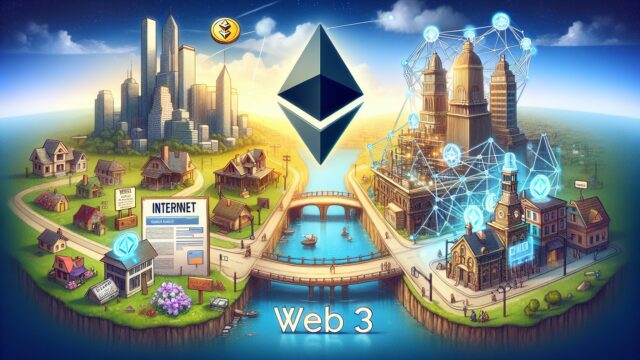
The Ethereum blockchain is arguably the most significant protocol within the world of Web3—a term often used to describe a new type of internet service built using decentralized blockchain technology. With its unique features and capabilities, Ethereum has carved out a space as the de facto platform for developing decentralized applications (dApps), executing smart contracts, and facilitating a new wave of digital innovation. In this article, we’ll delve into the depths of the Ethereum protocol, unveiling its core features, use cases, and potential impact on the future of technology.
Introduction
In 2015, Ethereum emerged as a groundbreaking innovation, expanding on the concept of blockchain technology that Bitcoin introduced. Conceived by Vitalik Buterin and a group of dedicated developers, Ethereum brought the novel idea of a programmable blockchain to life. This meant that, unlike Bitcoin’s primarily transactional nature, Ethereum allowed developers to create complex programs, or “smart contracts,” directly on the blockchain. Such functionality opened up a universe of possibilities for automating agreements and operations without the need for intermediaries.
Body
The Architecture of Ethereum
The core structure of Ethereum as a Web3 protocol rests on a distributed ledger, much like Bitcoin, but with a significant twist. Instead of processing just financial transactions, Ethereum’s blockchain is designed to handle executable code. The Ethereum Virtual Machine (EVM) is the runtime environment that facilitates this feature, operating on each network node and ensuring the execution of smart contracts uniformly across the platform.
Smart contracts are self-executing contracts with the terms of the agreement between parties directly written into code. These contracts execute automatically when pre-defined conditions are met, making the process trustless and eliminating the need for intermediaries. This feature is central to the idea of Web3, where users interact directly with decentralized services without going through centralized authorities.
Ethereum’s Native Currency: Ether
To participate in the Ethereum ecosystem, users need Ether (ETH), the platform’s native cryptocurrency. Ether is used to pay for transaction fees and computational services, a concept known as “gas.” Gas ensures that resources are efficiently allocated on the network and helps to prevent spam transactions, protecting the network’s integrity.
Decentralized Applications (dApps)
Ethereum’s ability to run dApps has cultivated a fertile ground for innovation. dApps are applications that run on a decentralized network, rather than on a single computer or server. This decentralization provides dApps with several advantages, such as resistance to censorship, uptime reliability, and improved security. The Ethereum protocol hosts a vast array of dApps, ranging from financial services (DeFi) and games to social media platforms and identity verification systems.
Decentralized Finance (DeFi)
One of the most influential sectors within the Ethereum ecosystem is decentralized finance. DeFi is an umbrella term for financial services powered by blockchain, with no central authority. Through Ethereum, users can lend, borrow, trade, and earn interest on cryptocurrencies, opening up financial systems to anyone with an internet connection.
Non-Fungible Tokens (NFTs)
Another innovation that Ethereum has popularized is the concept of non-fungible tokens or NFTs. Unlike cryptocurrencies, which are interchangeable, NFTs are unique digital assets that can represent ownership of a specific item or content, such as artwork, collectibles, or even real estate.
Ethereum 2.0 and Beyond
The Ethereum community is proactively addressing challenges such as scalability, energy efficiency, and transaction speed. Ethereum 2.0, or Eth2, is an ongoing series of upgrades aimed at improving the network’s overall performance and sustainability. These upgrades include the transition from proof-of-work to proof-of-stake consensus mechanism, which aims to drastically reduce energy consumption.
Conclusion
Ethereum stands out as a cornerstone of the Web3 movement, offering a flexible and dynamic protocol that has already revolutionized how we conceive digital interaction, ownership, and finance. Its role as a platform for innovation makes it more than just a cryptocurrency; it’s a foundational technology that has given rise to a new digital landscape.
The potential of Ethereum is vast, and as the protocol continues to evolve, we can expect even more groundbreaking applications and services to emerge. Whether you’re an entrepreneur, developer, or simply an enthusiast of cutting-edge technology, understanding Ethereum is vital for anyone looking to be part of the Web3 revolution. The journey through the decentralized web is just beginning, and Ethereum is leading the way into a future where the internet is more secure, inclusive, and user-centric.