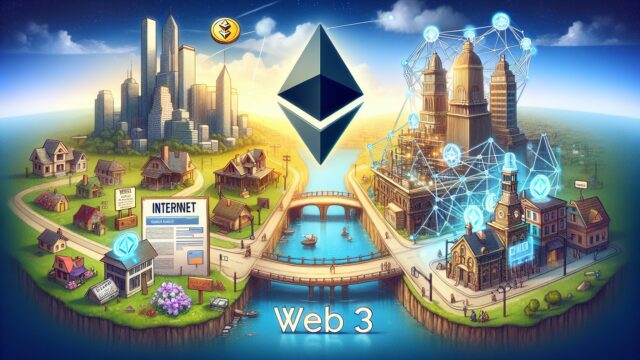

Exploring Ethereum: Understanding the Foundation of Web3

The Ethereum blockchain is arguably the most significant protocol within the world of Web3—a term often used to describe a new type of internet service built using decentralized blockchain technology. With its unique features and capabilities, Ethereum has carved out a space as the de facto platform for developing decentralized applications (dApps), executing smart contracts, and facilitating a new wave of digital innovation. In this article, we’ll delve into the depths of the Ethereum protocol, unveiling its core features, use cases, and potential impact on the future of technology.

Introduction

In 2015, Ethereum emerged as a groundbreaking innovation, expanding on the concept of blockchain technology that Bitcoin introduced. Conceived by Vitalik Buterin and a group of dedicated developers, Ethereum brought the novel idea of a programmable blockchain to life. This meant that, unlike Bitcoin’s primarily transactional nature, Ethereum allowed developers to create complex programs, or “smart contracts,” directly on the blockchain. Such functionality opened up a universe of possibilities for automating agreements and operations without the need for intermediaries.

Body

The Architecture of Ethereum

The core structure of Ethereum as a Web3 protocol rests on a distributed ledger, much like Bitcoin, but with a significant twist. Instead of processing just financial transactions, Ethereum’s blockchain is designed to handle executable code. The Ethereum Virtual Machine (EVM) is the runtime environment that facilitates this feature, operating on each network node and ensuring the execution of smart contracts uniformly across the platform.

Smart contracts are self-executing contracts with the terms of the agreement between parties directly written into code. These contracts execute automatically when pre-defined conditions are met, making the process trustless and eliminating the need for intermediaries. This feature is central to the idea of Web3, where users interact directly with decentralized services without going through centralized authorities.

Ethereum’s Native Currency: Ether

To participate in the Ethereum ecosystem, users need Ether (ETH), the platform’s native cryptocurrency. Ether is used to pay for transaction fees and computational services, a concept known as “gas.” Gas ensures that resources are efficiently allocated on the network and helps to prevent spam transactions, protecting the network’s integrity.

Decentralized Applications (dApps)

Ethereum’s ability to run dApps has cultivated a fertile ground for innovation. dApps are applications that run on a decentralized network, rather than on a single computer or server. This decentralization provides dApps with several advantages, such as resistance to censorship, uptime reliability, and improved security. The Ethereum protocol hosts a vast array of dApps, ranging from financial services (DeFi) and games to social media platforms and identity verification systems.

Decentralized Finance (DeFi)

One of the most influential sectors within the Ethereum ecosystem is decentralized finance. DeFi is an umbrella term for financial services powered by blockchain, with no central authority. Through Ethereum, users can lend, borrow, trade, and earn interest on cryptocurrencies, opening up financial systems to anyone with an internet connection.

Non-Fungible Tokens (NFTs)

Another innovation that Ethereum has popularized is the concept of non-fungible tokens or NFTs. Unlike cryptocurrencies, which are interchangeable, NFTs are unique digital assets that can represent ownership of a specific item or content, such as artwork, collectibles, or even real estate.

Ethereum 2.0 and Beyond

The Ethereum community is proactively addressing challenges such as scalability, energy efficiency, and transaction speed. Ethereum 2.0, or Eth2, is an ongoing series of upgrades aimed at improving the network’s overall performance and sustainability. These upgrades include the transition from proof-of-work to proof-of-stake consensus mechanism, which aims to drastically reduce energy consumption.

Conclusion

Ethereum stands out as a cornerstone of the Web3 movement, offering a flexible and dynamic protocol that has already revolutionized how we conceive digital interaction, ownership, and finance. Its role as a platform for innovation makes it more than just a cryptocurrency; it’s a foundational technology that has given rise to a new digital landscape.

The potential of Ethereum is vast, and as the protocol continues to evolve, we can expect even more groundbreaking applications and services to emerge. Whether you’re an entrepreneur, developer, or simply an enthusiast of cutting-edge technology, understanding Ethereum is vital for anyone looking to be part of the Web3 revolution. The journey through the decentralized web is just beginning, and Ethereum is leading the way into a future where the internet is more secure, inclusive, and user-centric.

Unraveling the Power of Ethereum: The Foundation of Decentralized Applications

The advent of Web3 is changing the landscape of the internet, heralding a new era of decentralized protocols. Among these, Ethereum stands out as a revolutionary platform that has been critical in fostering a robust ecosystem for decentralized applications (dApps). This post delves into Ethereum’s protocol, exploring its capabilities, impact, and potential for the future of decentralized technology.

Introduction

Ethereum, since its inception in 2015, has emerged as a key player in the world of blockchain and cryptocurrency. It is often regarded as the second generation of blockchain technology, following the first generation pioneered by Bitcoin. However, unlike Bitcoin, which is primarily a digital currency, Ethereum has a broader scope. Its goal is to provide a decentralized platform where developers can build and deploy dApps that run exactly as programmed without any possibility of fraud, censorship, or third-party interference. Let’s explore the magic of Ethereum and how it is shaping the future of decentralized applications.

Body

The Ethereum Protocol: A Closer Look

At the core of Ethereum is its protocol, which operates using a blockchain – a shared, immutable ledger that records transactions. The Ethereum protocol introduces several components that build on the basic concepts of blockchain technology inherited from Bitcoin. Central to its innovation is the Ethereum Virtual Machine (EVM), a powerful, decentralized computing engine that executes the code of dApps.

Smart Contracts

One of the critical features of Ethereum is the concept of smart contracts. Smart contracts are self-executing contracts with the terms of the agreement directly written into lines of code. They automate the execution of an agreement so that all participants can be immediately certain of the outcome, without intermediary’s involvement or time loss. These contracts run on the EVM, ensuring security and reliability.

Ether

The native cryptocurrency of the Ethereum network is called Ether (ETH). It serves as fuel for operating dApps on the Ethereum platform and is used as a means of compensation for participants who perform computations and validate transactions (miners). ETH also functions as a store of value and a medium of exchange within the ecosystem.

Decentralized Applications (dApps)

Ethereum’s architecture and smart contract functionality have opened the door for developers to create a wide range of dApps. These applications span various sectors, including finance (DeFi), gaming, art (NFTs), and more. dApps operate on a P2P network of computers rather than a single server, democratizing the ownership and governance of applications.

Ethereum 2.0: Transition to Proof of Stake

The Ethereum network is currently in the process of a significant upgrade known as Ethereum 2.0. This upgrade aims to address some of the scalability and efficiency issues associated with Ethereum 1.0. The most significant change in Ethereum 2.0 is the transition from a proof-of-work (PoW) consensus mechanism to proof-of-stake (PoS). This shift will reduce the energy consumption of the network and increase its transaction processing capacity.

The Impact of Ethereum

Ethereum’s impact on the blockchain space is undeniable. It has played a crucial role in propelling the widespread adoption of smart contracts and dApps. It has provided a foundation for the booming DeFi sector that is challenging traditional financial services and has introduced the world to the concept of non-fungible tokens (NFTs), creating an entirely new way to manage digital ownership and rights.

Conclusion

The Ethereum protocol remains at the forefront of the Web3 revolution, offering a robust and versatile foundation for the development of decentralized applications. As Ethereum continues to evolve, particularly with the upcoming Ethereum 2.0 upgrade, its potential to revolutionize various industries grows. For developers, businesses, and innovators looking to tap into the power of blockchain technology, Ethereum represents an avenue to build applications that are more secure, transparent, and resilient. The journey of Ethereum is a testament to the transformative power of blockchain, and its role in shaping a more decentralized digital future is just beginning.

Exploring IPFS: The Backbone of a Decentralized Web

The InterPlanetary File System (IPFS) is a groundbreaking protocol that is reshaping the way we think about data storage and distribution on the internet. With the aim of creating a more robust, distributed, and efficient web, IPFS stands out as a crucial player in the web3 ecosystem. In this article, we’ll delve into what IPFS is, how it works, and why it’s considered a foundational technology for a decentralized future.

Introduction

In an era where centralization has led to concerns over data ownership, privacy, and security, IPFS offers a compelling solution. It’s a peer-to-peer file-sharing system that seeks to make the web faster, safer, and more open. Unlike traditional web protocols that rely on centralized servers, IPFS facilitates file storage and access across a network of nodes, ensuring redundancy and resilience against censorship and data loss.

Body

The Genesis of IPFS

Developed by Protocol Labs and first released in 2015, IPFS was envisioned as a part of the larger “interplanetary” vision for the internet – one that could even span across space colonies. It stemmed from the realization that our conventional methods of data sharing and storage were unsustainable, especially in the face of an information-heavy future.

The Nuts and Bolts of IPFS

At its core, IPFS is a distributed file system that can store and access files, websites, applications, and data. The magic of IPFS lies in its use of content-addressing to identify files. When a file is added to IPFS, it is given a unique fingerprint called a Content Identifier (CID). This CID is a hash of the file’s contents. Consequently, when you access a file through IPFS, you’re not asking for it by its origin server’s location but by its content hash.

Content-Addressing and Deduplication

Content-addressing not only guarantees the authenticity of the data (since any change in the data alters the CID) but also inherently avoids duplication. If multiple copies of the same file exist across the network, they will all share the same CID. This deduplication makes data storage on IPFS incredibly efficient.

Decentralization and Resilience

Since there is no single point of failure in the IPFS network, information remains accessible even if parts of the network go down. This decentralized architecture offers resilience against censorship and ensures that information can’t be removed or suppressed easily. For places with unreliable internet infrastructure, this system allows for persistent access to content.

Speed and Performance

IPFS also speeds up the web by allowing users to download from the nearest node in the network rather than a central server potentially located halfway across the globe. Furthermore, because files are broken into smaller pieces and distributed across nodes, the network can handle multiple requests simultaneously, offering potentially faster access speeds and reduced bandwidth bottlenecks.

Challenges and Considerations

While IPFS solves several issues inherent in traditional web protocols, it also faces challenges. One is ensuring widespread adoption, as users and developers need to be willing to integrate and support a new system. Another challenge is the potential legal and ethical implications of immutable and uncensorable data storage. There’s also the matter of incentivization for nodes storing and distributing content, which initiatives like Filecoin are designed to address.

Conclusion

IPFS is a critical part of the web3 vision for a decentralized, resilient, and efficient internet. It breaks away from the limitations of centralized data storage, offering a peer-to-peer approach that is robust and censorship-resistant. While challenges remain in its path towards mass adoption, ongoing developments and complementary technologies keep the dream of an interplanetary internet alive. IPFS is not just a protocol; it’s a step toward a paradigm shift in how we think about and interact with digital content, signaling a substantial move towards truly democratizing the web. As more people and institutions understand and embrace its potential, IPFS is poised to become an integral part of our digital infrastructure.

Exploring Ethereum: The Foundation of Decentralized Applications

Introduction

Ethereum stands as a revolutionary technology in the blockchain space, providing a robust platform for decentralized applications (DApps) through its unique smart contract functionality. Since its inception in 2015 by Vitalik Buterin and other co-founders, Ethereum has become a foundational pillar of the web3 movement, which aims to create a more user-centric, privacy-respecting internet. In this article, we’ll delve into the intricacies of the Ethereum protocol, its ecosystem, and how it contributes to the landscape of decentralized technologies.

Body

The Ethereum Protocol

At its core, Ethereum is an open-source, blockchain-based platform that enables developers to build and deploy decentralized applications. Unlike Bitcoin, which was designed primarily for peer-to-peer transactions, Ethereum’s versatility comes from its ability to run smart contracts — self-executing contracts with the terms of the agreement directly written into code.

Smart Contracts

Smart contracts function autonomously and without the need for intermediaries, allowing for the creation of complex, trustless systems in which transactions are transparent, trackable, and irreversible. These contracts are written in a programming language called Solidity, which is specifically designed for the Ethereum Virtual Machine (EVM).

Ethereum Virtual Machine (EVM)

The EVM is the runtime environment for smart contracts on Ethereum. It is a quasi-Turing complete machine; the term “quasi” is used because computation on Ethereum is resource-bound with a mechanism called gas, which is used to limit the amount of computational work and storage used by a contract.

Gas and Ether

Transactions on Ethereum require a fee, paid in gas, which is purchased with Ethereum’s native cryptocurrency, Ether (ETH). Gas functions as a unit that measures the amount of computational effort required to execute operations; more complex operations or smart contracts with more code require more gas to run.

The Decentralized Ecosystem

Ethereum is more than its technology; it’s an ecosystem that has given rise to various decentralized applications across finance (DeFi), gaming, social networks, and more. This ecosystem is powered by the ERC-20 and ERC-721 standards, which have established the groundwork for the creation of tokens and non-fungible tokens (NFTs), respectively.

ERC-20 Tokens

ERC-20 tokens are fungible tokens that adhere to a set of standards on Ethereum, ensuring compatibility with the broader Ethereum ecosystem. This standardization has simplified the process for developers to create new tokens, leading to an explosion of new financial products and services in the DeFi space.

ERC-721 and NFTs

The ERC-721 standard, on the other hand, has paved the way for non-fungible tokens (NFTs). Unlike ERC-20 tokens, NFTs are unique digital assets representing ownership of a specific item or content, from digital art to in-game assets.

Web3 and Decentralization

Ethereum’s role in web3 goes beyond DApps and tokens; it’s about rethinking the power structures on the internet. By enabling decentralized autonomous organizations (DAOs), Ethereum empowers communities to operate and govern themselves without a centralized authority, potentially reshaping organizational structures across industries.

Conclusion

Ethereum has laid the foundation for a future where decentralized applications become commonplace, challenging the status quo of a centralized internet. Its contribution to the development of web3 is undeniable, with its scalable smart contract technology heralding a new era of innovation and internet functionality. As the Ethereum network continues to evolve with upgrades like Ethereum 2.0, which aims to improve scalability and security, it remains a critical building block in an increasingly decentralized world. Whether through DApps, DeFi, NFTs, or DAOs, Ethereum stands at the forefront of a technological transformation that promises to redefine our interaction with the digital realm.

Exploring IPFS: A Cornerstone Protocol of Web3

The rise of Web3 has seen a flurry of innovation and the development of various foundational protocols, each aimed at creating a more decentralized, user-centric internet. One such technology that stands at the forefront of this movement is the InterPlanetary File System (IPFS), a protocol designed to make the web faster, safer, and more open. In this article, we’ll delve into what IPFS is, how it works, and why it’s considered a crucial component of the Web3 ecosystem.

Introduction

In the world of Web3, decentralization is not just a buzzword; it’s the core philosophy. Traditional web infrastructure relies on centralized servers, which can lead to issues like single points of failure and censorship. IPFS seeks to address these problems by creating a distributed network of nodes that work together to host and distribute files. The protocol has been rapidly gaining attention as a way to circumvent censorship, reduce hosting costs, and improve access to information globally.

What is IPFS?

IPFS, short for InterPlanetary File System, is a peer-to-peer (P2P) hypermedia distribution protocol that aims to connect all computing devices with the same system of files. It was created by Juan Benet in 2015 and is now an open-source project supported by a strong community of developers and enthusiasts. Unlike the traditional HTTP protocol, which locates information through server-based addresses, IPFS accesses files through a content-addressed block storage model, with each block identified by a cryptographic hash.

How IPFS Works

Content Addressing

At the heart of IPFS is content addressing, which is fundamentally different from the location addressing of the HTTP/S protocol. When you add a file to IPFS, the data is broken down into smaller pieces, hashed, and given a unique fingerprint called a content identifier (CID). This CID is an address that reflects the content itself rather than its location. No matter where the data is stored or who is requesting it, the CID remains constant as long as the content doesn’t change, ensuring that the file can be retrieved by anyone in the network who has the correct CID.

Distributed File Storage

IPFS is built upon a distributed network of nodes that store and share files. When a user adds a file to IPFS, it becomes available to the network, and any node can help distribute it. Each node keeps an index of what content it has, and when someone else requests the file, the IPFS network uses a distributed hash table (DHT) to find out which nodes are storing the requested content. This means that instead of relying on a central server, content delivery can be handled by numerous nodes scattered around the world, which can greatly improve speed and reliability.

Versioning and Deduplication

IPFS has a built-in versioning system. Each time a file is updated, a new CID is created. This encourages immutable data, as each version remains retrievable by its unique CID. Additionally, IPFS implements deduplication, meaning that if multiple files share the same blocks of data, they will not be stored redundantly. This saves significant space and improves efficiency across the network.

Use Cases and Benefits

IPFS has several practical applications, including, but not limited to:

  • Decentralized Web Hosting: Websites and web applications can be hosted on IPFS, making them resistant to censorship and server failures.
  • Content Distribution: Media and content creators can distribute their work directly, without relying on centralized services.
  • Archiving: Data can be preserved in a distributed manner, preventing loss due to localized disasters or censorship.
  • Supply Chain: IPFS can be used for tracking goods as they move through a supply chain, with updates stored immutably on the ledger.
  • Digital Identity: IPFS can store identity documents in a secure, tamper-proof way.

The advantages of IPFS are numerous. It reduces the need for redundant storage, increases the speed of content delivery, provides resilience against censorship, and ensures content permanence and authenticity.

Conclusion

IPFS is more than a protocol; it’s a step towards a decentralized and robust Web3 ecosystem. While it’s not a panacea for all the internet’s issues, the system presents an innovative alternative to our reliance on centralized infrastructure. By enabling a distributed file storage solution, IPFS is leading the charge in transforming how data is stored, accessed, and disseminated across the globe.

As the Web3 space continues to develop, IPFS is likely to play a central role in the underlying architecture of a more decentralized internet. Whether it’s through facilitating DApp development, creating new content distribution networks, or safeguarding information against censorship, IPFS has shown that it is more than capable of rising to the challenge.

The growth of IPFS will depend on further adoption and meaningful integration into existing systems, but its potential for creating a more open and interconnected world is clear. As we reimagine the future of our digital lives, IPFS stands as a beacon of hope in the aspiration for a truly decentralized web.

Exploring Ethereum: The Foundation of Decentralized Applications

Since the introduction of Bitcoin in 2009, the blockchain technology landscape has seen an explosion of innovation and expansion. Among several groundbreaking protocols that have emerged, Ethereum stands out as a foundational layer for decentralized applications (dApps) and smart contracts. This article aims to shed light on the Ethereum protocol, its features, capabilities, and its impact on the burgeoning Web3 ecosystem.


Introduction

Ethereum, conceptualized by Vitalik Buterin and released in 2015, is a decentralized platform that enables developers to build and deploy smart contracts and dApps without any downtime, fraud, control, or interference from a third party. With its own native cryptocurrency, Ether (ETH), Ethereum has not only provided an alternative to Bitcoin but also expanded the possibilities of blockchain technologies by supporting decentralized finance (DeFi), non-fungible tokens (NFTs), and a host of other applications.


What Makes Ethereum Unique?

Smart Contracts and dApps

At the core of Ethereum’s uniqueness are smart contracts — self-executing contracts with the terms of the agreement directly written into code. These digital contracts run on the blockchain and automatically execute, control, or document legally relevant events according to the terms agreed upon by the parties involved. The versatility of smart contracts enables developers to create dApps that can serve a wide variety of functions across finance, gaming, social media, and more, fostering a new era of decentralized services.

Ethereum Virtual Machine (EVM)

The Ethereum Virtual Machine (EVM) is the engine that powers the operation of smart contracts on the Ethereum network. It is a powerful, sandboxed virtual stack embedded within each full Ethereum node, allowing the execution of bytecode — a set of instructions necessary for smart contracts. Because of the EVM, developers can create applications that are platform-independent, expanding the reach and potential interoperability of various software projects.

Decentralized Autonomous Organizations (DAOs)

Ethereum’s protocol has also given rise to the concept of Decentralized Autonomous Organizations (DAOs). DAOs are entirely autonomous, open-source organizations governed by smart contracts and operated collectively by members without central authority. This revolutionary idea has profound implications for the future of corporate governance and collaborative decision-making.

The ERC-20 and ERC-721 Token Standards

A significant contribution of the Ethereum protocol to the Web3 space is the ERC-20 token standard, which has become a blueprint for creating fungible tokens within the Ethereum ecosystem. Similarly, the ERC-721 standard has paved the way for the creation of unique, non-fungible tokens (NFTs). These standards have enabled a streamlined and consistent development process, fostering innovation and a booming digital economy built on Ethereum’s infrastructure.


Ethereum’s Scalability and Upgrades

While Ethereum has provided a robust platform for decentralized innovation, scalability has been an ongoing challenge due to the increasing number of transactions and complex smart contract operations. To address these issues, several upgrades, collectively known as Ethereum 2.0, are being rolled out. The upgrades aim to transition the network from a proof-of-work (PoW) consensus mechanism to a proof-of-stake (PoS) system, which will improve scalability, security, and energy efficiency. These changes are expected to significantly enhance the platform’s performance and sustainability, ensuring Ethereum’s continued dominance in the Web3 space.


Conclusion

Ethereum has pioneered the realm of smart contracts and dApps, facilitating an entirely new way of building decentralized platforms. Its contributions, such as the EVM, DAOs, and tokenization standards, have laid a solid foundation for the decentralized internet.

As Ethereum evolves with its ambitious 2.0 updates, the protocol remains at the forefront of the Web3 movement, shaping the future of how we interact with digital services. Its continued development and widespread adoption speak to its robustness and potential to empower a truly decentralized ecosystem that is open, secure, and accessible to all.

Exploring the Ethereum Blockchain: The Foundation of Web3 Protocols

Introduction

In the world of decentralized technology, the term ‘Web3’ often pops up, reimagining how we interact with the internet. Web3 represents a new paradigm where users have control over their data, identities, and assets, thanks to blockchain technology. The Ethereum blockchain, in particular, stands as the backbone for a myriad of Web3 protocols that pave the way for a decentralized future. In this blog post, we will delve into the Ethereum blockchain, understand its significance in the Web3 ecosystem, and how its smart contract capabilities enable a multitude of applications and innovations.

Body

What is Ethereum?

Ethereum is an open-source, blockchain-based platform that enables developers to create and deploy smart contracts and decentralized applications (dApps). It was proposed in late 2013 by a cryptocurrency researcher and programmer, Vitalik Buterin, and development was crowdfunded in 2014. The platform went live on July 30, 2015, with 72 million pre-mined coins.

Unlike Bitcoin, which is primarily a digital currency, Ethereum is a more versatile platform. Its internal cryptocurrency, Ether (ETH), is used to facilitate transactions and incentivize the network’s security.

How Ethereum Works

At the heart of Ethereum is its unique capability to execute smart contracts. Smart contracts are self-executing contracts with the terms of the agreement directly written into code. They run on the Ethereum Virtual Machine (EVM), which can execute scripts globally across its decentralized network of nodes.

Each node on the Ethereum network maintains a copy of the entire blockchain. These nodes are responsible for confirming and validating transactions and smart contracts, which are then added as new blocks to the blockchain. This process is secured by a consensus mechanism, which has transitioned from proof-of-work (PoW) to proof-of-stake (PoS) with the Ethereum 2.0 upgrade.

The Role of Ethereum in Web3

Web3 protocols seek to leverage decentralization to give users ownership and governance rights. Ethereum facilitates this through the creation of user-controlled wallets and identity systems, which are interoperable across different applications. With Ethereum, users can interact directly with dApps without the need for a centralized authority or intermediary.

Moreover, Ethereum’s capability to create and manage tokens, both fungible (like cryptocurrencies) and non-fungible (like digital art or collectibles), has led to the revolution known as Decentralized Finance (DeFi) and the burgeoning space of Non-fungible tokens (NFTs).

Ethereum-Based Web3 Protocols

Numerous Web3 protocols have been built on top of Ethereum, including:

  • DeFi Protocols: These allow for creating decentralized banking services without traditional financial intermediaries. Examples include lending protocols like Aave and Compound, decentralized exchanges like Uniswap and SushiSwap, and stablecoins like DAI.

  • Decentralized Autonomous Organizations (DAOs): DAOs utilize Ethereum smart contracts for governance without central leadership. An example is The DAO, which was one of the first attempts at a decentralized crowdfunding platform.

  • Oracles: Protocols like Chainlink, which bring real-world data onto the blockchain, allowing smart contracts to interact with external information.

  • NFT Marketplaces: These include platforms like OpenSea and Rarible that allow for the creation, buying, and selling of NFTs on the Ethereum blockchain.

Challenges and the Future of Ethereum

While Ethereum has proven to be a fertile ground for Web3 innovation, it’s not without its challenges. Scalability issues, high gas fees, and network congestion have raised concerns. However, the ongoing development of Ethereum 2.0 aims to address these problems by transitioning to a PoS consensus mechanism, implementing shard chains, and other scalability solutions.

Ethereum is also seeing competition from other blockchain platforms like Solana and Polkadot which offer differing approaches to scalability and interoperability. However, Ethereum’s large developer community and the diverse ecosystem continue to make it a leading platform for Web3 protocols.

Conclusion

Ethereum’s smart contract functionality and decentralized infrastructure are pivotal to the creation and success of Web3 protocols. By allowing for a trustless environment where transactions and agreements can execute automatically, Ethereum serves as the bedrock for innovation across finance, art, governance, and beyond. As Ethereum continues to evolve with the rollout of Ethereum 2.0, we can anticipate greater adoption, more robust services, and an expansive increase in the types of protocols built on this versatile platform. If Web3 is the future of the internet, Ethereum is undoubtedly one of the main architects shaping its foundation.

Dive into Ethereum: The Foundation of Web3 Protocols

Web3 has emerged as the next phase of the internet, offering a decentralized platform where users can interact, transact, and build upon without the need for centralized controls. At the heart of this new decentralized web is a collection of protocols, each designed to play a specific role in the functioning of the ecosystem. Among these, Ethereum has been a pioneering force. In this post, we will explore Ethereum in detail, understand its significance in the Web3 landscape, and see how it lays the foundation for the next generation of internet applications.

Introduction

Ethereum is often hailed as the poster child for Web3 protocols, not merely because it was one of the first to see widespread adoption, but because it introduced the concept of a programmable blockchain. Launched in 2015 by Vitalik Buterin and his co-founders, Ethereum extended the possibilities of the blockchain beyond simple financial transactions (which Bitcoin exemplified), fostering an environment where developers could create decentralized applications (DApps) with intricate functionalities.

Body

What is Ethereum?

At its core, Ethereum is a decentralized, open-source blockchain system that features smart contract functionality. Smart contracts are self-executing contracts with the terms of the agreement directly written into lines of code. These contracts run on the blockchain, making them tamper-proof and trustless. This means that once a smart contract is deployed on the Ethereum blockchain, it will execute exactly as programmed without any chance of fraud or third-party interference.

Ethereum’s native cryptocurrency is Ether (ETH), used to compensate participants who perform computations and validate transactions. Developers also use ETH to pay for transaction fees and services on the Ethereum network.

How Does Ethereum Work?

Ethereum’s blockchain is similar to Bitcoin’s in that it is a shared record of the entire transaction history. Every node on the network stores a copy of this history.

The big difference between Ethereum and Bitcoin is in the complexity of the smart contracts that can be built on Ethereum, allowing more than just peer-to-peer financial transactions. Ethereum’s virtual machine, the Ethereum Virtual Machine (EVM), enables the creation and operation of these smart contracts.

The recent update to Ethereum 2.0 has begun the process of transitioning from proof-of-work (PoW) to proof-of-stake (PoS) consensus mechanism, aiming to solve scalability issues and reduce the environmental impact of the network.

Ethereum’s Role in Web3

Ethereum has fueled the proliferation of a new internet era by enabling:

  • Decentralized Autonomous Organizations (DAOs): Organizations that are run by programming code rather than a central authority.
  • Decentralized Finance (DeFi): Financial services including exchanges, lending, and insurance that operate on the blockchain.
  • Non-Fungible Tokens (NFTs): Unique digital assets that are certifiably original and owned, ranging from art to in-game items.
  • DApps: From games to social media platforms, DApps operate without needing a central authority.

Each of these applications leverages the power of Ethereum’s smart contract capabilities and contributes to the ecosystem’s virtuous cycle of innovation and growth.

Challenges and Future Direction

Despite Ethereum’s central role in the development of Web3, it faces challenges such as network congestion, high gas fees, and scalability issues. The Ethereum community is addressing these with continuous improvements, including upgrading to Ethereum 2.0 and Layer 2 scaling solutions like rollups.

Furthermore, Ethereum encourages the development of decentralized infrastructures for a more open web, providing a blueprint and a foundational layer upon which other protocols and services can be built.

Conclusion

Ethereum has undeniably cemented its position as a crucial Web3 protocol, sparking a revolution in how we envision the future of the internet. It has enabled a new paradigm of decentralized applications and set the standard for blockchain functionality that extends beyond mere currency.

As we continue to explore the potential of Web3, Ethereum will likely remain at the forefront, not just as a platform for innovation but as a community driving the ethos of a permissionless and more equitable digital world. While challenges remain, Ethereum’s development points towards a maturing ecosystem more than capable of overcoming them, continually enriching the fabric of the decentralized web.

Unveiling the Potential of Ethereum: The Frontier of Web3 Protocols

Introduction

In the ever-evolving landscape of blockchain technology, Ethereum stands at the forefront as a revolutionary platform that has catalyzed the development of Web3. As a decentralized platform for building and running smart contracts and decentralized applications (DApps), Ethereum has set the standard for what next-generation internet technologies can achieve. This article delves deep into Ethereum, unraveling its fundamental features, advantages, and the impact it has on both the current and future state of the web.

Body

What is Ethereum?

Ethereum is an open-source, blockchain-based platform that enables developers to build and deploy decentralized applications. Conceived in 2013 by programmer Vitalik Buterin, Ethereum went live in 2015 and brought about a paradigm shift in how applications could be created and operated. Unlike its predecessor Bitcoin, which is primarily a digital currency, Ethereum’s blockchain is designed to be programmable, meaning it can execute complex applications as part of its blockchain operations.

Smart Contracts

The core feature that differentiates Ethereum from other blockchain protocols is its smart contract functionality. Smart contracts are self-executing contracts with the terms of the agreement directly written into code. They run on the Ethereum Virtual Machine (EVM) and automatically enforce and facilitate the terms of a contract when certain conditions are met, without the need for intermediaries.

Smart contracts power a wide range of applications, from financial tools like loans and insurance to gaming and digital collectibles known as NFTs (Non-Fungible Tokens). Their self-executing nature significantly reduces the potential for fraud and dispute, and enhances the efficiency of transactions.

Ethereum as a Platform

As a platform, Ethereum provides these advantages:

Decentralization

No single entity controls Ethereum. It’s maintained by a global network of computers, known as nodes, that together ensure the security, immutability, and distributed nature of the platform. This also means that applications built on Ethereum can benefit from these same characteristics.

Interoperability

Ethereum’s standard protocols, such as ERC-20 for fungible tokens and ERC-721 for non-fungible tokens, have facilitated the creation of an ecosystem where different applications and services can interact seamlessly.

Flexibility and Innovation

Ethereum’s support for smart contracts enables developers to push the boundaries of what’s possible. From DeFi (Decentralized Finance) to DAOs (Decentralized Autonomous Organizations), Ethereum remains at the cutting edge of innovation in blockchain and cryptocurrency.

Challenges and Upgrades

However, Ethereum is not without its challenges. Scalability issues have resulted in high gas fees (transaction fees) and slower transaction times during periods of congestion. To address these concerns, Ethereum has embarked on a series of upgrades known as Ethereum 2.0, which aims to transition the network from a Proof of Work (PoW) to a Proof of Stake (PoS) consensus mechanism. This shift promises to significantly enhance the network’s efficiency, security, and scalability.

Conclusion

Ethereum’s impact on the web is profound and ongoing. By providing a decentralized platform for smart contracts and applications, Ethereum has laid the groundwork for a new era of the internet—Web3, characterized by user sovereignty, enhanced security, and reduced reliance on central authorities. Despite its challenges, Ethereum continues to evolve and adapt, ensuring its place as a cornerstone web3 protocol in the blockchain ecosystem for years to come. As developers, businesses, and users increasingly embrace Ethereum and its capabilities, the potential for transformative change across industries is vast, signaling an exciting future for the decentralized web.


This was just a brief overview of Ethereum, one of the most prominent Web3 protocols defining the future of the internet. Stay tuned for more articles exploring other protocols in the growing Web3 landscape.

Exploring the Future of Finance with Decentralized Protocols: Introducing Aave

The advent of blockchain technology has not only reshaped the concept of money but also the infrastructure underpinning financial transactions. In the ever-expanding universe of Web3, a variety of protocols have emerged, forging pathways towards a decentralized future. Today, let’s delve deep into Aave, a pioneering protocol in the decentralized finance (DeFi) space, painting a new picture for lending and borrowing across the globe.

Introduction

Aave, a Finnish word translating to “ghost,” represents the transparency and fluidity within this innovative protocol. It has materialized as a go-to platform for crypto enthusiasts looking to leverage their idle assets. Aave is a decentralized protocol that enables users to lend and borrow cryptocurrencies without the need for a centralized intermediary. Founded by Stani Kulechov in 2017, Aave encompasses a broad array of crypto assets, providing liquidity and unlocking passive income opportunities for its users.

Body

What is Aave?

Aave operates on the Ethereum blockchain, tapping into the power of smart contracts to manage, automate, and secure all transactions within the protocol. With its open-source and non-custodial structure, users have full control over their assets, circumventing traditional bottlenecks and security concerns that come with centralized entities.

The Mechanics Behind Aave

Users who wish to earn interest on their cryptocurrencies can deposit them into Aave’s liquidity pools. These pools serve as the foundational layer for lending out assets to borrowers. In return for providing liquidity, depositors earn ‘aTokens’, which represent their share in the pool and continuously accrue interest.

Borrowers, on the other hand, can take out loans by putting up collateral higher than the loan’s value, maintaining the protocol’s security and solvency. A unique aspect of Aave is its incorporation of flash loans – a feature allowing borrowers to take out uncollateralized loans, provided they are paid back within the same Ethereum transaction block.

Aave’s Native Token: AAVE

AAVE is the native governance token of the protocol, instrumental in the security and decision-making processes that guide Aave’s future. Holders of AAVE can propose, vote on improvements, and stake their tokens within the protocol, earning staking rewards and bolstering Aave’s defense mechanisms.

The Benefits of Aave

Aave presents numerous advantages that are reshaping the ethos of financial engagement:

  • Decentralization: By removing intermediaries, Aave offers a trustless environment where transactions rely on the impartiality of code.

  • Passive Income: It paves the way for users to earn interest passively on their crypto holdings.

  • Access to Credit: Aave provides borrowing opportunities without the stringent requirements traditionally imposed by banks.

  • Innovations: Offerings like flash loans have created new arbitrage, and financial strategies were impossible before DeFi.

  • Community Governance: AAVE token holders are empowered to affect the direction in which the protocol evolves.

Challenges and Considerations

The DeFi space, while promising, does come with its own set of challenges. Smart contract vulnerabilities, liquidation risks, and the volatility of cryptocurrencies can affect Aave users. It is also subject to regulatory scrutiny as governments around the world grapple with the rapid innovation in the digital asset space.

Conclusion

Aave stands as a testament to human ingenuity and the continuous quest for financial democratization. It embodies the principles of Web3, prioritizing transparency, accessibility, and user empowerment. While the experience on Aave can be rewarding, potential users must thoroughly research and understand the inherent risks involved in DeFi. The platform is consistently evolving, addressing challenges, and incorporating feedback, heralding a new era of finance where the old guard and conventions are gradually being phased out by groundbreaking, decentralized protocols. Aave is not just a protocol; it’s a movement toward an inclusive financial ecosystem where everyone, regardless of their background, has a ghost of a chance to succeed.