
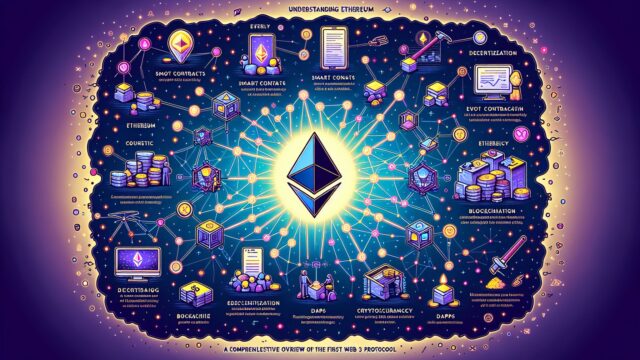
Web3 protocols fundamentally reinvent how digital services are built and delivered. Powering the future of decentralized networks and platforms, they promise to revolutionize the way we interact with digital platforms. Among these protocols, Ethereum undeniably reigns as a cornerstone. This post explores the Ethereum protocol in detail.
Introduction
In simple terms, Ethereum is a decentralized platform that enables developers to build and deploy smart contracts and decentralized applications (dapps). Serving as a foundational layer for a multitude of applications, Ethereum goes well beyond being a simple cryptocurrency. It is best understood as a programmable blockchain that allows complex operations to be executed, unlike its predecessor, Bitcoin, which serves primarily as a digital currency.
What is Ethereum?
Named after the hypothetical invisible medium that permeates the universe, enabling light to travel, Ethereum is an open-source, blockchain-based protocol invented by programmer Vitalik Buterin. Ethereum was introduced to overcome the limitations of Bitcoin and to leverage blockchain’s capabilities beyond peer-to-peer electronic cash transactions.
How does Ethereum work?
Ethereum extends the basic functionality of blockchain by using its database to include programmable scripts or smart contracts, executed on a decentralized network. It operates using the computational resource, “Ether,” which can be thought of as the fuel needed to execute operations on the platform.
Smart Contracts
An essential concept of Ethereum is smart contracts. A smart contract is a self-executing contract embedded with the terms of the agreement between buyer and seller being directly written into code. This code resides on the blockchain and automatically executes contractual obligations without the need for an intermediary.
Decentralized Applications (DApps)
Ethereum’s platform supports decentralized applications (dApps), which are open-source applications that leverage blockchain technology. Since these applications are decentralized, they negate the need for any central authority to manage and moderate transactions and data.
Ethereum Virtual Machine (EVM)
Another major component of Ethereum is the Ethereum Virtual Machine (EVM). It’s a computing environment where smart contracts are processed and executed. The EVM also acts as a sandbox for smart contracts, isolating them from the main Ethereum network to ensure network security.
Why is Ethereum important?
Ethereum is monumental to the web3 movement because it democratizes online services and breaks away from the control wielded by tech conglomerates. This decentralization, coupled with transparency, paves the way for a host of applications, from decentralized finance (DeFi) and games to governance and the internet of things (IoT).
What are the challenges?
Despite its advantages, Ethereum is fraught with challenges. Scalability remains its most pertinent issue. The network can only process a set number of transactions at any given time, slowing the pace exponentially as more users join the platform. This leads to a bottleneck, making transactions expensive and slow. To overcome this, Ethereum 2.0 was proposed, which aims to implement a new consensus mechanism that can potentially solve the scalability issue.
Conclusion
Given its innovative capabilities, it’s clear why Ethereum is leading the charge in the world of web3 protocols. Its unique infrastructural components – smart contracts, dApps, and the EVM – fortify its stance as a pioneer. However, it needs to quickly address its scalability issues to maintain its dominance, especially in the face of disruptive up-and-comers in the blockchain arena. Nonetheless, Ethereum’s importance in democratizing online services and promoting decentralized applications is undeniable. With many exciting developments on the horizon, it will be fascinating to observe Ethereum’s evolution and the future of the web3 space.